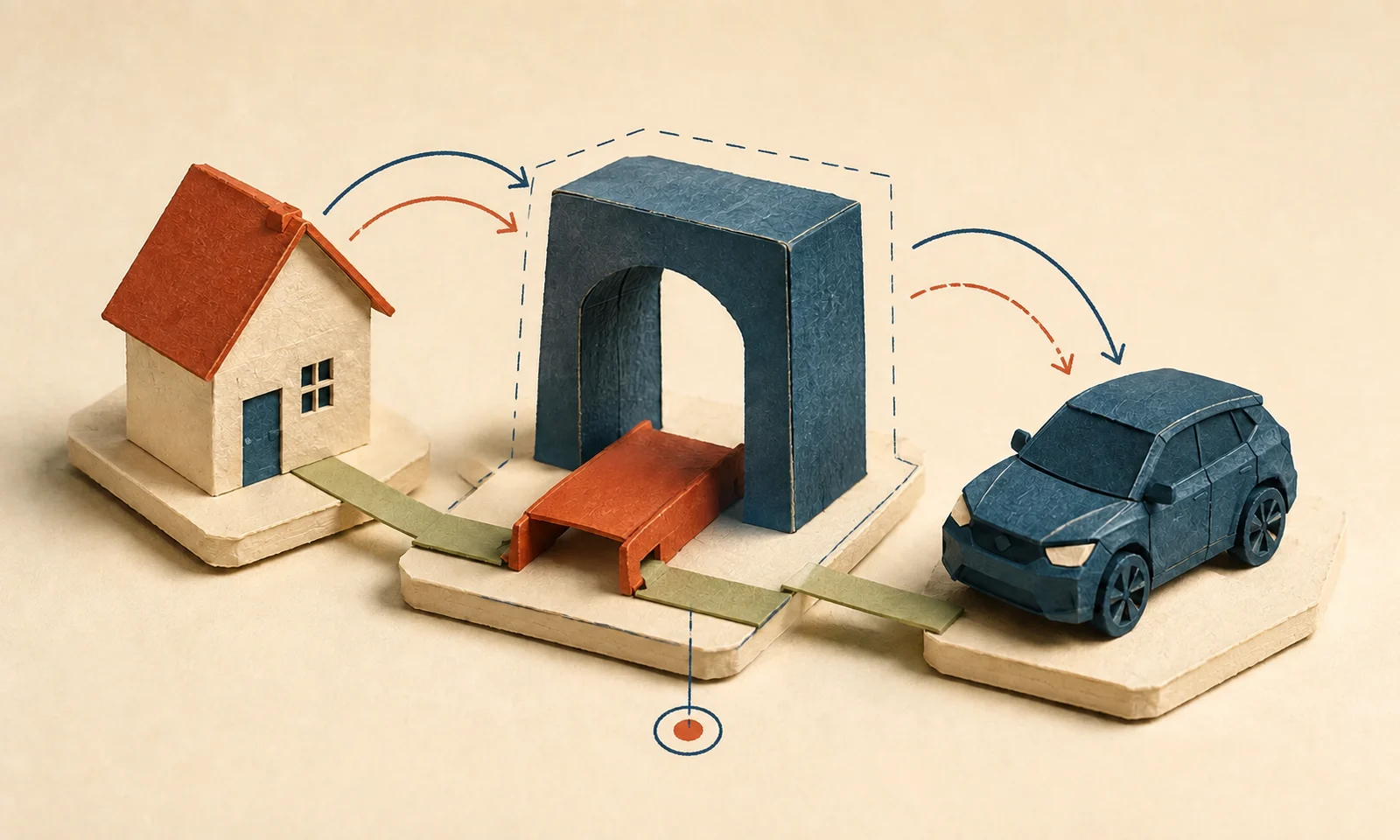
This project started as a simple Home Assistant annoyance: a newer connected vehicle integration did not behave the way I expected.
At first, it looked like a normal third-party integration problem. Some data appeared. Some entities were missing. Some remote actions failed. The confusing part was that nothing was cleanly broken. The system was half-working, which made it much harder to tell whether the issue was Home Assistant, the custom integration, the underlying library, the vehicle generation, or the provider’s backend.
That turned the project into a useful debugging story. The goal was to understand the layers well enough to explain where the assumptions had drifted, while keeping a clear personal boundary around how far the experiment should go.
Outcome
The investigation produced a repeatable authentication test harness, clearer read-only vehicle data, and integration changes for a newer vehicle generation and partial entity data. Remote commands remained unresolved: the evidence pointed to a different modern command path, but did not establish a working replacement.
The starting point
The setup had several moving parts:
- Home Assistant running as part of the homelab.
- A custom connected-vehicle integration.
- An underlying Python library.
- A newer vehicle generation.
- Authentication, MFA, session handling, status reads, and remote actions.
That was too much to debug all at once. When a system has that many layers, every failure can look like every other failure.
The first useful decision was to move outside Home Assistant and build a small standalone test harness. That gave me a cleaner place to test login, token reuse, account data, vehicle retrieval, and basic read behavior without the noise of the full integration lifecycle.
First false lead
The first library path I tried looked plausible, but it targeted the wrong regional backend.
That explained why the login flow and service assumptions did not match my account. It was a small but important reminder: similar package names and similar brands do not mean the same infrastructure. Connected services can vary by region, generation, app version, and account type.
That false lead was useful because it narrowed the problem. The issue was not just “the integration is broken.” Part of the issue was that older assumptions about the service path no longer matched the current system I was trying to use.
Authentication was the first real layer
Once I moved to the correct service family, authentication became the next obstacle.
The older code assumed a simpler login model. The current flow involved more callback-style prompts, locale selection, login-method selection, MFA handling, session persistence, and stable device identity.
I updated the local test harness enough to make login repeatable. That changed the whole debugging process. Instead of repeatedly getting stuck at the front door, I could reuse a session, inspect responses, and test one layer at a time.
The lesson was straightforward: authentication is often where integrations age first. A provider can change a challenge, callback, or session requirement without changing the visible user-facing feature at all.
Reading data was not the same as sending commands
After authentication worked, read-only data started to make more sense. Vehicle information and status data could be retrieved, but the integration still did not behave correctly inside Home Assistant.
One issue was classification. The newer vehicle identified itself with a generation value the integration did not understand yet. The data existed, but the code did not know which path to place it on. Adding the newer generation to the modern-vehicle handling path made the car appear more correctly in Home Assistant.
Another issue was entity registration. Some entities only appeared if data existed during the first setup pass. If a capability was supported but not populated yet, Home Assistant never created the entity at all. I changed that behavior so supported entities could be registered first and remain unavailable until real data arrived.
That was one of the most useful design lessons in the whole project:
Missing right now != impossible
Unavailable right now != unsupported
Partial data != no capability
In asynchronous systems, the difference matters.
The command path was different
The hardest part was separating read success from command success.
At one point, the integration could authenticate, identify the vehicle, and read useful status data, but remote actions still failed. It was tempting to keep changing payload shapes, headers, command names, app hints, and request details forever.
Those tests were still useful, but mostly because they eliminated bad theories. The responses were consistent enough to suggest the problem was not just a typo or a missing header. The older command path still responded, but that did not mean it was the correct path for the newer vehicle generation.
Eventually the pattern became clearer: modern read and command flows were split across different service layers. Some older paths were still present, but newer remote actions appeared to use a different command-and-status pattern.
That was the key architectural shift. A working endpoint is not always the authoritative endpoint. Sometimes it is just a historical layer that still answers enough to keep you guessing.
Integration maintenance along the way
While mapping the larger behavior, I also found ordinary integration maintenance issues:
- auth callback handling needed updates
- reauthentication had async edge cases
- Home Assistant service registration had deprecation cleanup
- newer vehicle generation handling needed to be widened
- entity registration needed to better tolerate partial data
That mix felt very real. The project was not one clean bug. It was protocol drift, generation drift, provider changes, and normal code aging stacked together.
What I learned
This was a good reminder that debugging connected systems is less about one magic fix and more about layer isolation.
The useful workflow was:
Home Assistant integration fails
  -> isolate the provider layer
  -> test authentication separately
  -> verify account and vehicle retrieval
  -> separate reads from commands
  -> compare old assumptions against current behavior
  -> patch the integration where the model is too narrow
A few lessons stuck:
- Half-working integrations can be more misleading than fully broken ones.
- Regional and generation-specific behavior matters.
- Authentication drift often appears before the rest of the system looks broken.
- Classification bugs can hide working data.
- “No data yet” should not automatically mean “no entity exists.”
- A responding endpoint is not always the correct workflow.
- The most useful writeup is the debugging arc, not every private detail behind it.
Personal boundary
This is also the kind of project where I wanted the learning to stay grounded.
It was interesting because it touched a real system I use, but that also made it different from a throwaway lab experiment. I wanted to understand what was happening, fix what I could responsibly fix, and keep the story centered on the method rather than turning it into a checklist.
The useful part of the work was the process: isolate layers, test assumptions, read errors carefully, patch stale models, and know when a third-party integration has drifted away from the system it depends on.
Next pass
The next step would be to keep the deeper technical notes private and let the public version stay focused on the arc of the investigation.
If I continue working on the integration, I would want cleaner logs, a safer test harness, clearer entity availability rules, and a more maintainable way to track provider changes without relying on guesswork every time something shifts.
The satisfying part was not just making pieces work. It was getting from “this integration is weird” to “I can explain which assumptions expired and why.”